
Cliff Swallow Nesting Structure at Edge Hill
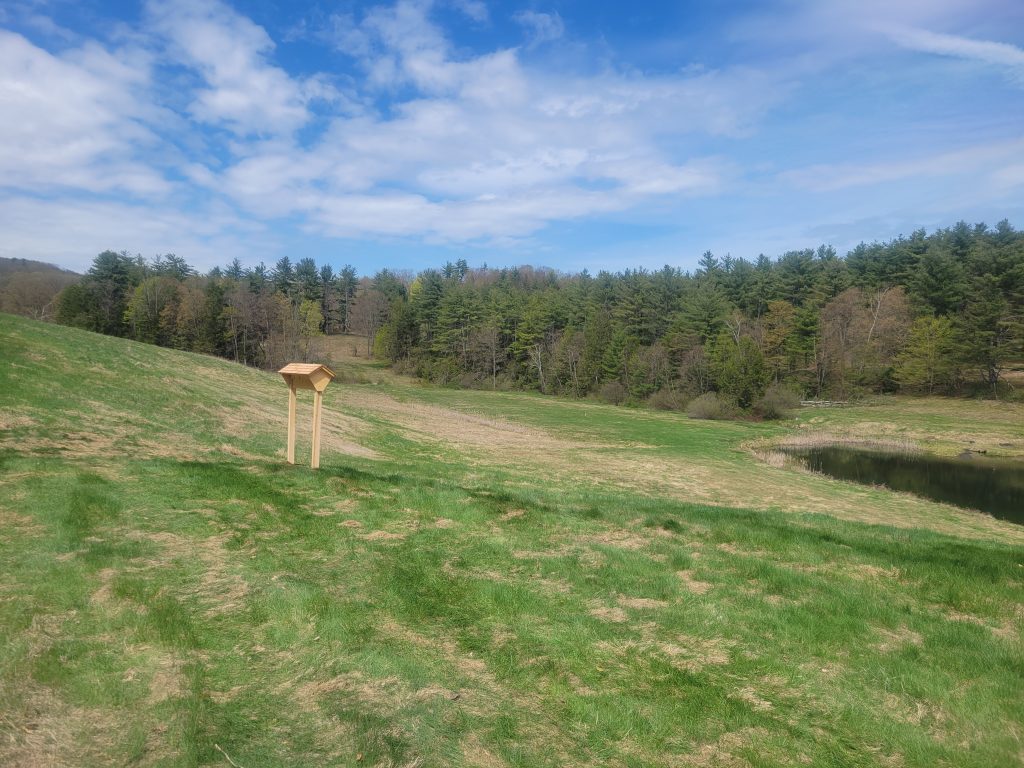
If you are traveling on Barnes Road in Ashfield past FLT’s newly-acquired Edge Hill property, you might notice a structure near the barn that at first glance looks like an information kiosk—but it’s not—it’s a Cliff Swallow nesting structure!
Most people are more familiar with Barn Swallows, which build cup-shaped nests of mud inside barns. In New England, Cliff Swallows are found in similar habitats as Barn Swallows, but they construct their bottle-shaped nests under eaves. While they still nest on cliffs in the West, in the Northeast they are most often found nesting under the eaves of barn and other buildings and occasionally bridges. They are often encountered on farms, where there are open fields with insect prey, their sole food source, plenty of mud for nest-building, and eaves for nesting. The Edge Hill property appears to have all these habitat features except the gambrel roof barn is not conducive to nest building, as there is very little space under the steep eaves of the barn for nests. Enter the free-standing nesting structure.
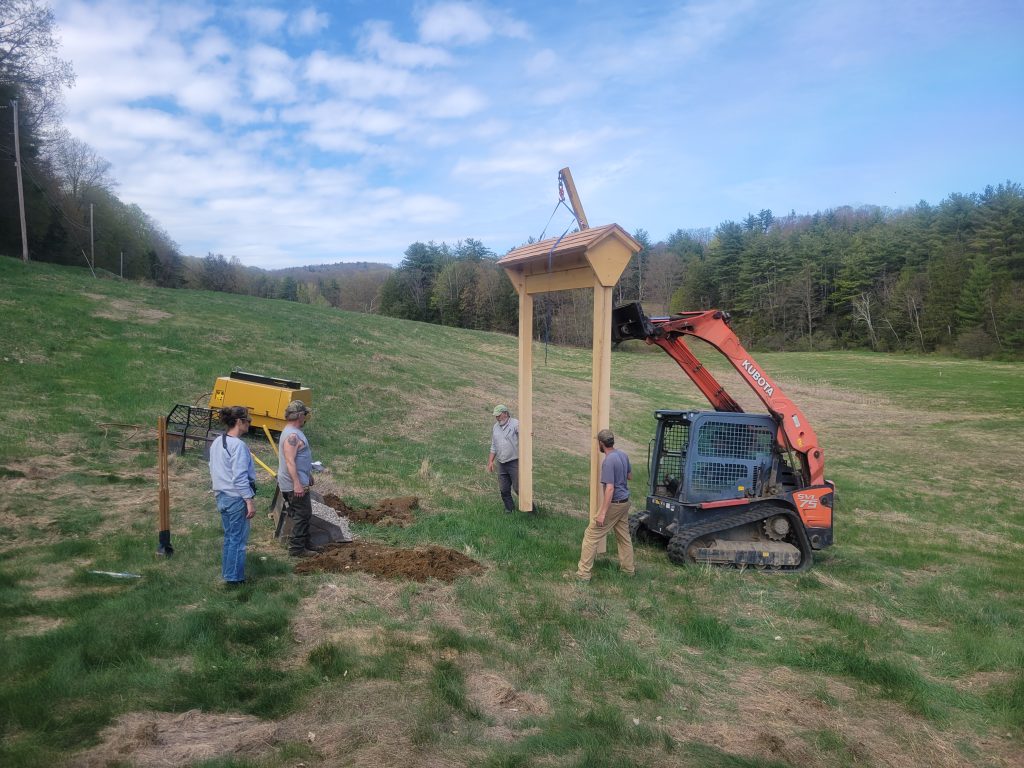
This solid pine and oak structure stands 9 feet tall when installed, is 8 feet wide, and provides roomy eaves on both sides of the peaked roof and plenty of protection from weather. Since Cliff Swallows are extremely colonial and are attracted to the sounds of other Cliff Swallows, the structure is outfitted with speakers broadcasting breeding calls. Cliff Swallows are also attracted to old nests (nests remaining from previous years), so 20 artificial fired clay nests made to mimic Cliff Swallow nests are installed on the structure, 10 on each side.
Cliff Swallow populations are in steep decline in the Northeast. Once a common bird of farms, there are now fewer than 8 known colonies of these birds nesting in Massachusetts. Factors thought to be contributing to declines include habitat loss, with the loss of small-scale farming and the regrowth of forests, competition from introduced House Sparrows, nests falling from eaves, extreme weather events related to climate change, changes in insect prey, and pesticide use.
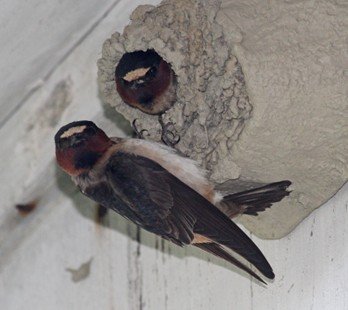
Cliff Swallows nesting in artificial clay nest in Shelburne, MA. Photo by David McIntyre
It is hoped that the sounds of breeding calls and the presence of artificial ceramic nests that look like real nests will draw nesting Cliff Swallows to this seemingly ideal spot. However, the benefit of the structure is that if it doesn’t attract Cliff Swallows in its current location, it can be relocated to a new site on the property or to a different FLT property. In the meantime, we are keeping an eye on the structure in hopes that the Cliff Swallows join in the jubilant flocks of Tree Swallows and Barn Swallows already flying at Edge Hill before beginning their long journey to South America in September, where they spend the winter.
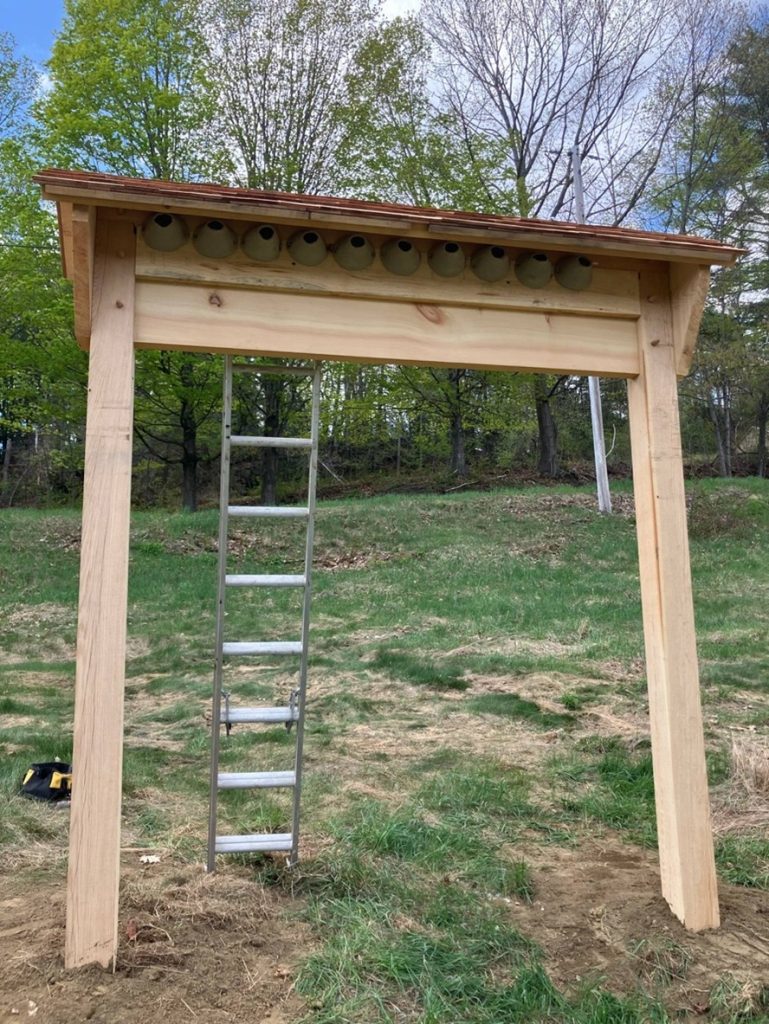
Cliff Swallow nesting structure after installation at the Edge Hill property. Photo by Mara Silver.
This project was initiated by Swallow Conservation, a nonprofit organization founded by Mara Silver (see www.swallowconservation.org). The project was funded by the Georgia Ornithological Society’s Lydia Thompson Grant. Swallow Conservation commissioned the structure, which was co-designed with The Cruck Father LLC, who built the structure. Mara Silver made and installed the clay nests and sound system under the eaves. Dick Hillman very generously donated his work and time to this project, both transporting and installing the structure, and we are very grateful to him for this generous act toward conservation.