
Saving A Place For Solitude
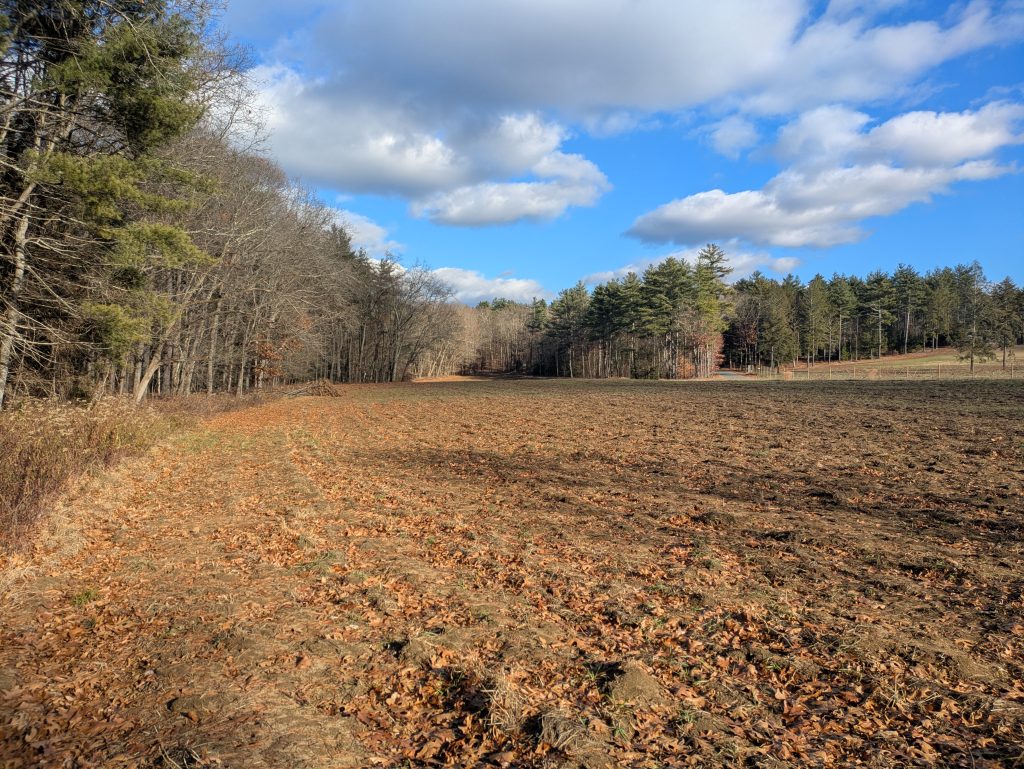
IN MONTAGUE, THE FRANKLIN LAND TRUST (FLT) finalized a donated conservation restriction on approximately 32 acres of farm and forest land along Old Sunderland Road, formerly part of the historic Craven Farm. The property includes active agricultural soils, managed forestland, and roughly 500 feet of Cranberry Pond Brook, a cold-water fisheries resource near its confluence with the Connecticut River. The land holds significant scenic value and lies within a landscape of extensively conserved farmland and forest.
The project was made possible through the generosity of landowner Elinor “Nell” Wright, whose personal connection to the land stretches back many years.
“I biked by this place fifteen years ago,” Nell recalls. “I remember the view without phone poles, the very old house with a For Sale sign, and Mount Toby on the other side.” She later bought the house in 2013, along with several acres, from a direct descendant of the original builder. “The land we’re conserving now—the 30 acres along the road—wasn’t for sale then.”
The opportunity came later, during a difficult personal moment. “The year my parents died, they left me an acre of land on the water on the Cape. I sold it for Cape prices and used that money to buy these 30 acres,” she explains. “I had been away helping my parents and missed the chance to buy the 60 or so acres directly across the street. That land has since become a farm.”
Nell also discovered an unexpected connection to her family: “The day I moved in, I walked around the block and took pictures,” she says. “My mom never came here, but when she saw the photos of the tobacco barn, she remembered helping with the tobacco harvest as a college student in the 1940s. They were ferried across the river from Deerfield.”
Although she describes her move to Montague as somewhat serendipitous—“I moved here rather randomly after a divorce”—the landscape itself resonates deeply. “The exposed granite along the river south of here really speaks to me,” she says. “It’s funny, because I was born in Rhode Island, and those old flagstone walls still move me, too.”
When it comes to daily life on the conserved land, Nell values observation. “We’ve walked and snowshoed there occasionally, but I mostly prefer to watch from here,” she says. “The wildlife eventually pokes out. Bears, deer, coyotes, foxes, owls, snapping turtles, pileated woodpeckers.”
Her decision to conserve the land was driven by both personal and long-held values. “Protecting my view,” she admits plainly. “I like solitude, and I didn’t want rampant development of the fields, which are still being farmed.” She adds that she has long been an advocate for undeveloped land.
“My first campaign was in high school, when a group of us convinced the town to buy 400 acres in the center of town. Now there’s a summer theater and a conservatory there, along with kettle holes, native beech trees, glacial erratics, runners and walkers.”
Nell has also worked locally to support thoughtful planning. “I’ve been involved in town projects to find the right places for housing and to make it affordable,” she says. “Montague has a great town planner.”
Looking ahead, Nell is candid. “I’m feeling pretty hopeless right now about our collective future, and I’m not sure my actions make much difference,” she reflects. “But if animals—and people who need to—can walk and breathe and sing in these woods, that’s a step.”