
Along The Fall River
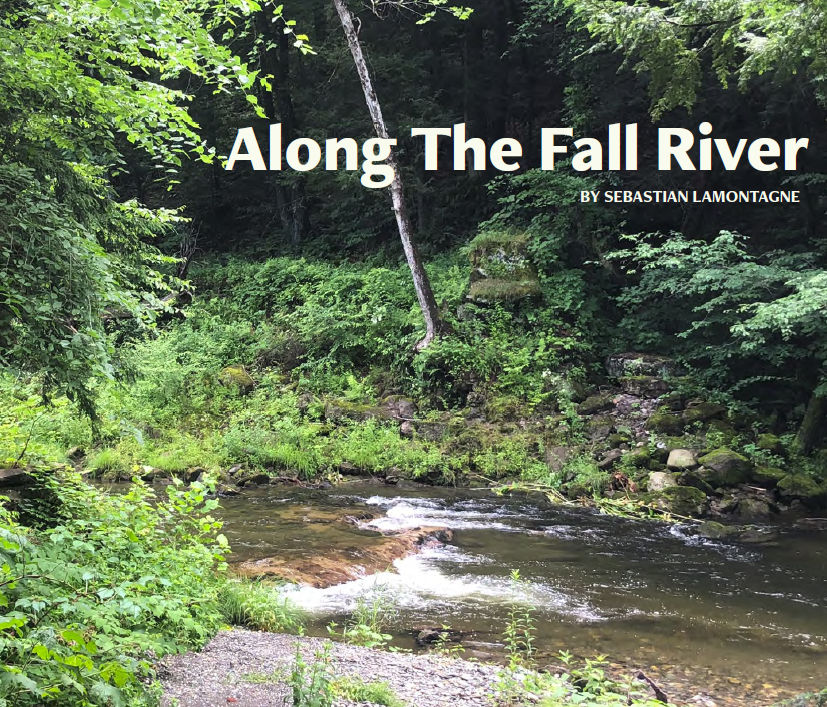
THIS PAST NOVEMBER THE FRANKLIN LAND TRUST secured permanent conservation of the Stotz Family’s property in Gill and Greenfield, through a Conservation Restriction (CR). The family donated a CR covering more than 88 acres of forestland, which safeguards over 6,000 feet of riverbank along the Fall River. This cold-water fishery begins in Guilford, Vermont, and flows southward through Bernardston, then between Greenfield and Gill, before ultimately joining the Connecticut River just downstream from the Great Falls Dam in Turners Falls.
For Princy Stotz, the decision to conserve is the result of a long-held promise. “My husband Doug and I always shared a wish that our land be conserved forever and never developed,” she says.
As the Fall River passes through the Stotz Family’s property, it winds through a steep, rocky ravine that remains remarkably intact, despite intensive industrial use during the 19th century in what was known as “Factory Hollow.” Doug Stotz grew up nearby in Riverside, Gill, and spent much of his childhood exploring the area. Princy recalls him sharing stories of those days, including run-ins with the property’s former owner: “Doug played in and around Factory Hollow as a kid and told stories about the owner then, Burt Reed, shooting a shotgun full of rock salt at him and his friends to shoo them away.”
The Stotz family eventually purchased the property. “Burt Reed’s widow, Alice, sold the place to his daughter, Rachel Wood and her husband Don. And we were fortunate enough to buy it from the Woods in 1986. They were moving to a condo which was too small for their two German Shepards, so we took them as part of the deal! We used to joke that we really liked the dogs so we bought the place so we could have them.”
Princy and her husband Doug spent three decades there together before Doug’s passing in 2016. “Doug and I enjoyed 30 wonderful years here together,” she says. “And I’ve been fortunate enough to be able to continue living here well into my eighties, with the help of my sons Mark and Doug.”
A dam along the river—another remnant of this industrial past—was removed in 2014 by the U.S. Fish & Wildlife Service, following years of collaboration with the Stotz family and state partners. Its removal restored river connectivity and increased the potential for anadromous fish such as eels, sea lamprey, and shad to return and use the river as spawning habitat. “In 2012, a dam on the Fall River on the property was removed as a result of us working with both the state and the U.S. Fish and Wildlife Service,” Princy notes. “That was an important moment for us.”
Life along the river has been a constant source of joy and grounding. “Every day of the 40 years I’ve spent here has been a blessing,” Princy reflects. “The river has a life and moods of its own and is a constant calming presence—save the occasional passing hurricane or dam break.” Wildlife, too, is ever-present. “We’ve had bald eagles nest in a dead tree here, and have a bear constantly trying to raid our bird feeders.”
The conserved land lies near Peskeompskut, a fishing and agricultural village that was a seasonal home to the Pocumtuck people and their neighbors for thousands of years, and the site of a massacre of Native Americans during King Philip’s War. Today, these 88 acres remain part of a living landscape shaped by human relationships stretching back millennia.
After Doug’s death, Princy began taking concrete steps to ensure their shared vision would endure. “I discussed these wishes with my son Doug, who was familiar with Conservation Restrictions,” she explains. “He connected me with the Franklin Land Trust. While it took several years, they helped us navigate the process and reach my—and my husband’s—objectives.”
Looking ahead, Princy sees this conservation effort as part of something larger. “This land is actually part of a wonderful conserved corridor on both sides of the Fall River in Gill and Greenfield,” she says. “The Fall River earns its name by dropping about 125 feet over these three miles. I’m thrilled my family’s land will be playing such an important role in conserving this priceless resource forever.” She adds, “At the same time, I’m pleased my children and grandchildren will be able to continue enjoying this legacy.”
Franklin Land Trust has been honored to work with the Stotz Family and grateful for their enduring commitment to conserving an ecologically rich and historically significant landscape.